Categories
Abner "Longie" Zwillman Bahamas Benjamin "Bugsy" Siegel Casino History Casinos / Gambling Saloons / Card Clubs / Slot Routes / Wire Services / Hotels / Racetracks / Racinos Cuba England Ethnic Groups: Italian Americans Ethnic Groups: Jewish Americans Gambling Gambling History Gaming History Haiti Israel It Really Happened Joe Adonis Law Enforcement / Judicial System: U.S. FBI Director J. Edgar Hoover Lebanon Louis Lepke (Buchalter) Meyer Lansky Miami Beach--Florida United States Vincent "Jimmy Blue Eyes" Alo

10 Intriguing Facts About Gambling Legend Meyer Lansky

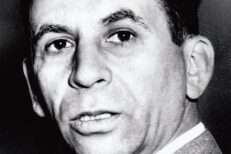
A young Lansky

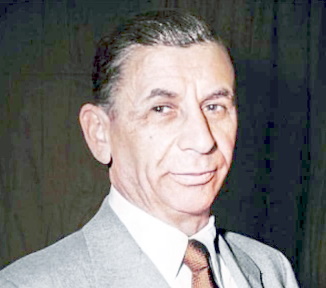
Meyer Lansky, né Maier Suchowljansky (1902-1983), just may be the U.S. icon of 20th century gambling, illegal and legal.

After being instrumental in creating the National Crime Syndicate, an amalgam of Italian-American Mafia and Jewish-American Mobsters, he worked his way up to its top position of chairman. His role, self-chosen, was facilitating the development, overseeing the finances and managing the skimming distributions of the syndicate’s many casinos around the world. He did so with only an eighth grade education.

Nicknamed “The Genius” and “The Mob’s Accountant,” Lansky was a visionary, planner, strategist, problem solver and long game player, as described in his biographies.

As for his personal life, briefly, he emigrated at age 9 with his family from Grodno, Poland (now in Belarus) to the States and lived in Manhattan’s Lower East Side in New York. In adulthood, he was married twice and had three children. Lansky admired French emperor Napoleon Bonaparte (another man of short stature and determination), most appreciated the poem “Desiderata” and loved the color blue (his wardrobe staple).

Here are 10 interesting tidbits about Meyer Lansky, the businessman:

One of Lansky’s illegal gambling operations was here

1) Lansky’s primary career goals after the National Crime Syndicate formation were to develop a foundation for future operations, become indispensable to the conglomerate’s Mobster members by making them money through gambling and in doing so, keep a low profile and stay mysterious. Once accomplished, which was the case by the 1950s, he pursued further expanding his gambling empire globally.

“Wealth was not the objective, for of that he had more than enough, nor were the trappings of power,” author Hank Messick wrote about Lansky. “It was the exercise of power that Lansky enjoyed; to study others, to profit by their mistakes was his technique.”

2) The gambling enterprises under Lansky’s purview included ones he owned solely, some he co-owned in partnerships and others in which he held points, or from which he received a percentage of the skim.

He was involved with gambling clubs and dog race tracks in the U.S. states of Florida, Arkansas, Louisiana, New York, Nevada, Kentucky, Mississippi and Alabama along with Cuba, England, the Bahamas, Haiti and Lebanon.  In his later years, he was working on developing casinos in Jamaica, the Virgin Islands, Hong Kong, Bogota, Hawaii, and the French Riviera.

Due to his auto repair and modification skills, Lansky was called the master of the Model T

3) Along with gambling, Lansky was involved in numerous businesses during his lifetime. They included the tool and die, auto repair and modification, murder for hire, bootlegging, narcotics and coin-operated machines businesses.

“No matter where you went, the Mob had its finger in the pie,” a Mobster wrote about the National Crime Syndicate’s growing portfolio of enterprises, “and usually it was Meyer Lansky’s finger,” as recounted by the authors of The Money and The Power.

Author Albert Fried wrote in The Rise and Fall of the Jewish Gangster in America that Lansky “more than anyone else grasped the emergent possibilities of gangster-capitalism.”

4) Lansky schemed and facilitated the prison release (a pardon by New York Governor Tom Dewey in this case) for Mafia head, Charles “Lucky” Luciano, in 1946 by helping create and fostering a means by which Luciano could contribute meaningfully to the World War II effort. The opportunity was through Operation Underworld, in which Mobsters (under imprisoned Luciano’s direction with Lansky as the go-between) controlled and prevented mayhem at New York’s ports.

5) Lansky secretly turned against and even orchestrated the fall of some fellow National Crime Syndicate members when it suited his purpose, often to eliminate potential competition. It’s well known that he approved the murder of his childhood friend and fellow gangster, Benjamin “Bugsy” Seigel, but Lansky also greenlighted hits on Abner “Longie” Zwillman, another longtime friend and associate, as well as Luciano loyalist, New York Mafioso Joe Adonis (born Giuseppe Antonio Doto).

Lansky

In another example, Lansky betrayed longtime associate, Louis Lepke (né Buchalter). Four months before Lepke was indicted by a federal grand jury for narcotics smuggling, he went into hiding. Wanting Lepke captured and convicted, Lansky brought about his surrender, through a mediary of course, on the false promise of getting the deal of not being prosecuted by New York state. (Lepke later was found guilty and sentenced to 14 years in prison, after which he was convicted of extortion and sentenced to 30 years to life.)

6) Lansky allegedly blackmailed J. Edgar Hoover in the 1930s with incriminating sex photos he somehow had obtained of the FBI director and his top deputy Clyde Tolson.

“The pictures were said to hold at bay this most formidable of potential adversaries,” wrote authors Sally Denton and Roger Morris.

7) Despite 60 years in the underworld, having committed various crimes and having been arrested many times, Lansky beat six murder charges and only spent 3 months, 16 days behind bars, between May and July 1953.

Alo

8) Lansky’s best friend, confidant and ally was Vincent “Jimmy Blue Eyes” Alo, a high-ranking capo in New York’s Genovese crime family.

“Alo and Lansky hit it off from the start,” John William Tuohy wrote. “Both were small men, 5’3″, and only a year apart in their ages. They were both basically shy men who had crawled out of the almost unbelievable poverty of the New York slums. They were book loving, low profile, chain smokers without much to say to those they didn’t know. Over the years, Alo had grown to represent Lansky’s muscle, a perpetual reminder to the outside world that the reasonable and business-like Lansky was protected by the Mafia.”

9) Lansky purchased a resort in the Florida Keys in 1951 for U.S. Mobsters to go, hide and recreate during the Kefauver Committee’s hearings. The Plantation Key Yacht Harbor was located ideally, close enough to yet far enough away from the mainland.

10) Lansky moved to Israel in 1970 to spend the rest of his years there, but the country rejected and expelled him. Instead, he returned to and resumed life in Miami Beach, Florida, where he eventually passed away in his sleep at age 80 on January 15, 1983 from lung cancer. His net worth at the time was said to have been $57,000 versus its peak in the late 1960s of $300 million.

“I wouldn’t have lived my life any other way,” Lansky told the authors of Meyer Lansky: Mogul of the Mob in 1978. “It was in my blood, my character. Environment certainly had something to do with it, but basically my own personality determined my fate. … I have nothing on my conscience. I would not change anything.”

Sources

Categories
Bahamas Casino History Casinos / Gambling Saloons / Card Clubs / Slot Routes / Wire Services / Hotels / Racetracks / Racinos Crimes / Violence / Punishments: Skimming Cuba England Flamingo (Las Vegas, NV) Gambling Gambling History Gaming History Haiti Israel It Really Happened Lebanon Meyer Lansky Miami Beach--Florida United States

Mobster Meyer Lansky Tries to Desert USA

1970-1972

Meyer Lansky was the puppeteer behind the scenes of the world’s gambling stage from the 1930s to the 1970s, controlling and manipulating the characters, or National Crime Syndicate members, with aplomb.

He capitalized on his brilliant financial acumen to develop and skim from an international casino empire — encompassing various U.S. states, Cuba, England, Haiti, the Bahamas and Lebanon  — that generated obscene amounts of money. At the height of his success in this endeavor, the late 1960s, this Eastern Europe-born immigrant, né Maier Suchowljansky, was worth an estimated $300 million ($2.3 billion today).

New Home Sought
At age 68, Lansky and his second wife Thelma (“Teddie”) moved from Miami Beach, Florida to Israel in October 1970 and four months later, applied for citizenship, as the Mobster wanted to live out the rest of his life there. It’s unknown if the reason was his Zionist beliefs or desire to distance himself from potential future criminal charges in the United States. Perhaps it was a bit of both.

“I don’t want to make money here,” Lansky told the Haaretz newspaper. “I am Jewish and I want to live here.”

At that time, under its Law of Return, Israel allowed all Jews from elsewhere except criminals to move there and become naturalized.

However, by that time, a number of racketeers already were using that country as a safe haven from legal reprisal back home. They included gamblers Morris Schmertzter aka Max Courtney, Al Mones, Hyman “Hymie” Segal and Frank Hitter aka Red Reed, along with other underworld players.

In March, two months after Lansky requested Israeli citizenship, a U.S. federal grand jury indicted him for skimming profits from the Flamingo hotel-casino in Las Vegas between 1960 and 1967. When he failed to appear before the grand jury after being subpoenaed, he was charged with contempt of court. Neither offense, however, required Israel to extradite Lansky under its treaty with the U.S.

The underworld’s financial ace told the newspaper, Maariv, he didn’t intend to return to the U.S. because he couldn’t be guaranteed a fair trial. He added that he was a retired, honest gambler, not a gangster.

In September 1971, after an investigation into Lansky’s background, Israel’s Interior Ministry denied him citizenship on the grounds he “was likely to be a threat to public order” (Reno Evening Gazette, Jan. 14, 1972).

Dissatisfied, Lansky and his attorney took the issue to the Supreme Court of Israel. A temporary injunction allowed the “The Mob’s Accountant” to stay put until resolution of the case.

Both Sides Make Plea
Before the high court, in March 1972, Israel’s state attorney, Gavriel Bach, asked the jurists to reject Lansky’s appeal. Bach argued that granting Lansky citizenship would set a dangerous precedent in that, according to reports from the FBI, Interpol and Scotland Yard, Lansky was deeply involved in organized crime in the States and Canada, with connections worldwide. In fact, the British agency had noted in a report the gaming impresario had tried to arrange a summit with some of his criminal cohorts in Tel Aviv in May 1971.

As if to punctuate Bach’s points, while the proceedings were underway, in June 1972, Lansky was indicted again in the U.S., that third time for conspiring to evade federal income taxes on money received from gamblers on junkets to a London casino. Bach informed the court of that development, too. He noted, however, that Israel wouldn’t deport the accused even if it ultimately were to deny him citizenship.

Attorney Yoran Alrio presented Lansky’s side at the proceeding. Alrio argued that his client simply wanted to retire in Israel out of Jewish religious sentiment, that he lacked a criminal record excluding some minor offenses and that the allegations of a criminal past and connections were simply “rumors, slander and gossip” (Nevada State Journal, March 24, 1972). Alrio quoted an FBI report indicating Lansky had been inactive for seven years.

The Verdict, Implications
Three months later, the supreme court announced its decision; it denied Lansky’s appeal for citizenship, meaning he had to leave Israel.

One and a half months later, at October’s end, with Lansky still not gone, the Interior Ministry gave him two weeks to depart or face expulsion. Technically, it wasn’t a deportation or extradition, as Israel wasn’t mandating that Lansky return to the U.S. Rather, he was free to go where he pleased … assuming the country of his choice would have him.

Within the given deadline, the underworld chieftain left the Holy Land with a Paraguayan visa. Yet, when he arrived at the airport in Asunción, he was prevented from disembarking the plane. He continued on the flight through South America to Florida. By mid-November, Lansky, then age 70, was back in the U.S., again taking up residence in Miami Beach.

Sources